

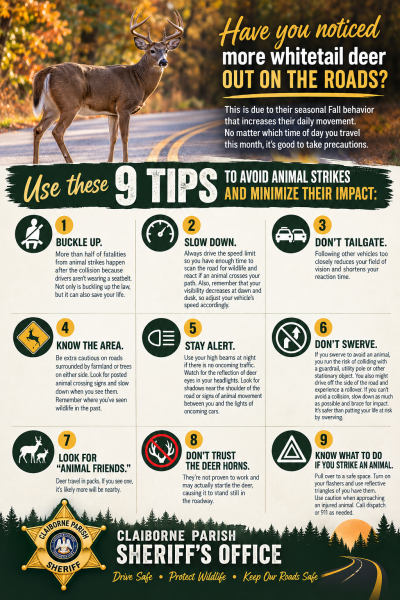
Have you noticed more whitetail deer out on the roads? This is due to their seasonal Fall behavior that increases their daily movement. No matter which time of day you travel this month, it's good to take precautions.
Use these 9 tips to avoid animal strikes and minimize their impact:
1. Buckle up. More than half of fatalities from animal strikes happen after the collision because drivers aren't wearing a seatbelt. Not only is buckling up the law, but it can also save your life.
2. Slow down. Always drive the speed limit so you have enough time to scan the road for wildlife and react if an animal crosses your path. Also, remember that your visibility decreases at dawn and dusk, so adjust your vehicle's speed accordingly.
3. Don't tailgate. Following other vehicles too closely reduces your field of vision and shortens your reaction time.
4. Know the area. Be extra cautious on roads surrounded by farmland or trees on either side. Look for posted animal crossing signs and slow down when you see them. Remember where you've seen wildlife in the past.
5. Stay alert. Use your high beams at night if there is no oncoming traffic. Watch for the reflection of deer eyes in your headlights. Look for shadows near the shoulder of the road or signs of animal movement between you and the lights of oncoming cars.
6. Don't swerve. If you swerve to avoid an animal, you run the risk of colliding with a guardrail, utility pole or other stationary object. You also might drive off the side of the road and experience a rollover. If you can't avoid a collision, slow down as much as possible and brace for impact. It's safer than putting your life at risk by swerving.
7. Look for "animal friends." Deer travel in packs. If you see one, it's likely more will be nearby.
8. Don't trust the deer horns. They're not proven to work and may actually startle the deer, causing it to stand still in the roadway.
9. Know what to do if you strike an animal. Pull over to a safe space. Turn on your flashers and use reflective triangles of you have them. Use caution when approaching an injured animal. Call dispatch or 911 as needed.